
FY 2027 HHS Budget Signals Structural Shift, Targeted Cuts and Increased Oversight
Highlights
- The U.S. Department of Health and Human Services (HHS) released the fiscal year (FY) 2027 Budget in Brief and accompanying congressional justifications, outlining the Trump Administration's funding priorities and proposed structural changes across federal health programs.
- Funding reductions remain significant but are more targeted than in FY 2026, signaling a moderated approach focused on efficiency, oversight and program integrity.
- Major entitlement reforms are notably absent, suggesting the administration may pursue Medicare and Medicaid changes through regulatory or congressional engagement rather than the budget process.
The U.S. Department of Health and Human Services (HHS) on April 3, 2026, released the fiscal year (FY) 2027 Budget in Brief and accompanying congressional justifications, outlining the Trump Administration's funding priorities and proposed structural changes across federal health programs.
Though the U.S. Congress ultimately determines final funding levels, the president's budget provides an important signal of policy direction – particularly with respect to program restructuring, funding priorities and areas of increased oversight.
Here are President Donald Trump's FY 2027 budget, the HHS Budget in Brief and various agency budget justifications to Congress:
- Administration for a Healthy America
- Administration for Children, Families, and Communities
- Administration for Strategic Preparedness and Response
- Advanced Research Projects Agency for Health
- Centers for Disease Control and Prevention (CDC)
- Centers for Medicare & Medicaid Services (CMS)
- U.S. Food and Drug Administration (FDA)
- Indian Health Service
- National Institutes of Health (NIH)
At a high level, the FY 2027 budget reflects a continued emphasis on federal program consolidation, targeted funding reductions, program integrity and administrative modernization, alongside a broader effort to realign HHS operations with the administration's Make America Healthy Again (MAHA) agenda under HHS Secretary Robert F. Kennedy Jr.
Secretary Kennedy is currently scheduled to appear before Congress six times over the next month:
- April 16. U.S. House of Representatives Committee on Ways and Means and House Committee on Appropriations Subcommittee on Labor-Health and Human Services, Education, and Related Agencies
- April 21. House Committee on Energy and Commerce and U.S. Senate Committee on Appropriations Subcommittee on Labor-Health and Human Services, Education, and Related Agencies
- April 22. Senate Committee on Finance and Senate Committee on Health, Education, Labor, and Pensions
These hearings will serve as an early test of congressional receptivity to the administration's proposed restructuring of HHS, funding reductions and programmatic priorities. They will also provide a key forum for broader policy discussions, including program integrity, public health restructuring, and Medicare and Medicaid oversight, even in the absence of formal legislative proposals in the budget itself.
HHS Restructuring Remains a Central Priority
The FY 2027 budget once again assumes implementation of a significant restructuring of HHS, largely consistent with the FY 2026 proposal, though with some modifications. Central to this effort is the creation of the Administration for a Healthy America (AHA), which would consolidate programs across the Health Resources and Services Administration (HRSA), Substance Abuse and Mental Health Services Administration, Office of the Assistant Secretary for Health and select CDC functions into a single entity focused on prevention and public health.
This restructuring reflects a broader policy shift toward reducing fragmentation, increasing coordination and providing states greater flexibility through consolidated funding streams. Behavioral health emerges as the largest investment area within AHA, alongside continued – though reduced – support for primary care, maternal and child health, and HIV/AIDS programs.
The budget also proposes a number of additional structural changes, including:
- transferring responsibility for the 340B Drug Pricing Program from HRSA to CMS
- establishing new offices within the Office of the Secretary, including Strategy and Civil Rights and Appeals
- reorganizing NIH institutes with more targeted consolidations (rather than the sweeping restructuring proposed last year), including the proposed consolidation of the National Institute of Drug Abuse and the National Institute on Alcohol Abuse and Alcoholism into a new National Institute of Substance Use and Addiction Research, and the elimination of certain institutes and centers such as the National Center for Complementary and Integrative Health and Fogarty International Center
- creating a new National Center for Chemicals and Toxins within CDC
Notably, though the restructuring framework remains intact, the FY 2027 proposal reflects a more incremental approach compared to FY 2026, particularly with respect to NIH. The proposed reorganization of HHS from the administration's prior budget request in FY 2026 was ultimately not included by Congress as part of the final funding package FY 2026, indicating the administration and Congress may remain at odds on a path forward.
Funding Levels Reflect Moderated but Continued Reductions
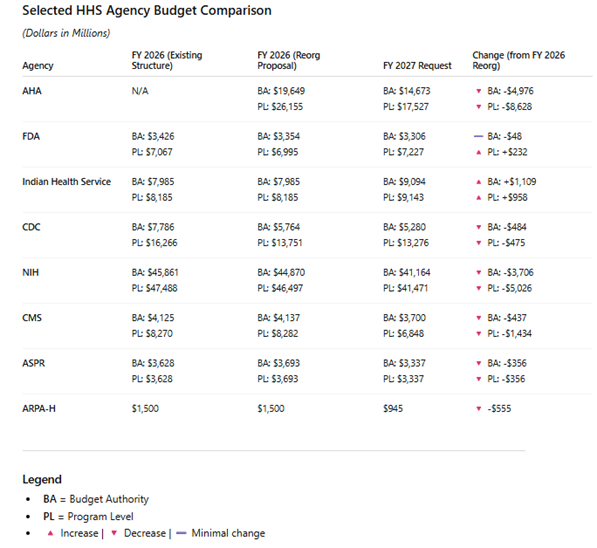
The administration requests $111.1 billion in discretionary funding for HHS, representing a $15.8 billion (12.5 percent) reduction from FY 2026 enacted levels. Although still significant, these cuts are notably smaller than those proposed in the FY 2026 budget.
The FY 2027 HHS Budget Request includes two discretionary program spending charts: one reflecting the reorganization proposal on pages 8 through 11 and another reflecting the current HHS structure on page 10.
Key agency-level trends include:
- NIH. Reduced by $3.7 billion, a substantially smaller cut than the ~$17 billion reduction proposed last year
- CMS. Reduced by $437 million, with a focus on operational efficiency and oversight
- CDC. Reduced by $484 million, alongside continued program consolidation and a refocusing on preventing the spread of infectious diseases
- FDA. Slight reduction in budget authority but an increase in total program funding driven by user fees
Overall, the budget reflects a shift away from large-scale structural funding reductions toward a more targeted reallocation of resources, while still maintaining downward pressure on discretionary spending.
CMS Priorities: Program Integrity, Modernization and Oversight
The FY 2027 budget places a strong emphasis on CMS operations, particularly around program integrity and administrative modernization.
Key priorities include:
- $2.8 billion for fraud, waste and abuse prevention through the Health Care Fraud and Abuse Control and Medicaid Integrity programs
- investments in Medicare operations, including $811 million for Parts A and B administration and $112 million for Parts C and D
- continued development of ClaimsCore, a modernized Medicare claims processing system incorporating artificial intelligence (AI)
- expanded oversight of the 340B Drug Pricing Program, assuming its transfer to CMS
The budget also signals a broader effort to rebalance contractor and federal workforce roles, improve oversight of healthcare facilities and strengthen digital infrastructure across Medicare systems.
Continued Focus on Public Health Restructuring and State Flexibility
Within AHA and across public health programs, the budget reflects a clear shift toward:
- consolidation of categorical grant programs into flexible block grants
- increased state-level discretion in program implementation
- reduced federal investment in certain prevention and public health activities, including elements of HIV/AIDS and chronic disease programming
At the same time, the administration maintains targeted investments in core safety-net programs, including federally qualified health centers, rural health initiatives and behavioral health services.
Research, Innovation and Supply Chain Priorities
Despite funding reductions, the budget continues to emphasize innovation and long-term system resilience, including:
- NIH research focused on chronic disease, aging and scientific rigor
- FDA investments in domestic manufacturing, AI-enabled oversight and food safety, including new initiatives such as formalizing establishment of the FDA PreCheck program to support advanced pharmaceutical manufacturing and targeted funding to remove unsafe chemicals from the food supply
- Administration for Strategic Preparedness and Response (ASPR) funding to strengthen medical supply chains and emergency preparedness, including the Strategic National Stockpile and domestic active pharmaceutical ingredient reserves, with continued investment in the Biomedical Advanced Research and Development Authority ($1.8 billion) and supply chain resilience infrastructure such as the Strategic Active Pharmaceutical Ingredient Reserve
- Advanced Research Projects Agency for Health investments in high-risk, high-reward health technologies, though at reduced funding levels
These priorities align with broader administration goals around domestic production, supply chain security and technological modernization.
Notably Absent: Medicare and Medicaid Legislative Proposals
For the second consecutive year, the budget does not include legislative proposals to reform Medicare or Medicaid, diverging from prior administrations' use of the budget as a vehicle for entitlement reform. This is particularly notable given that prior budget submissions – including those during the first Trump Administration – used the budget to try and achieve significant mandatory savings proposals had they been enacted by Congress.
This omission suggests the administration may be pursuing a different strategy: potentially advancing policy changes through regulatory action or direct engagement with Congress outside the budget process, rather than through formal budget proposals.
Notably, the budget does include a number of legislative proposals across HHS. For example, the FDA request outlines proposals aimed at advancing the agency's mission, including enhanced oversight of critical food products for infants and children and expanded enforcement authorities related to tobacco and e-cigarettes. The budget also includes two legislative proposals for CDC and a broader package of proposals for ASPR. In addition, it requests an extra $48 million to support continued implementation of the No Surprises Act.
Key Takeaways
- The FY 2027 budget reinforces a continued push toward HHS restructuring, with AHA as the centerpiece.
- Proposed funding reductions remain significant but are more moderate and targeted than in FY 2026.
- CMS priorities center on program integrity, operational modernization and increased oversight, including renewed efforts to bring 340B under CMS.
- The administration is advancing a broader shift toward state flexibility, program consolidation and streamlined federal operations.
- Agency-level priorities reflect a continued emphasis on chronic disease research, domestic manufacturing, supply chain resilience and technology-enabled oversight across NIH, FDA, CDC and ASPR.
- Despite the absence of major entitlement reform proposals, the budget signals continued focus on fraud prevention, administrative simplification and technology-enabled system improvements.
If you have any questions, please reach out to the authors or another member of Holland & Knight's Healthcare Team.
Information contained in this alert is for the general education and knowledge of our readers. It is not designed to be, and should not be used as, the sole source of information when analyzing and resolving a legal problem, and it should not be substituted for legal advice, which relies on a specific factual analysis. Moreover, the laws of each jurisdiction are different and are constantly changing. This information is not intended to create, and receipt of it does not constitute, an attorney-client relationship. If you have specific questions regarding a particular fact situation, we urge you to consult the authors of this publication, your Holland & Knight representative or other competent legal counsel.